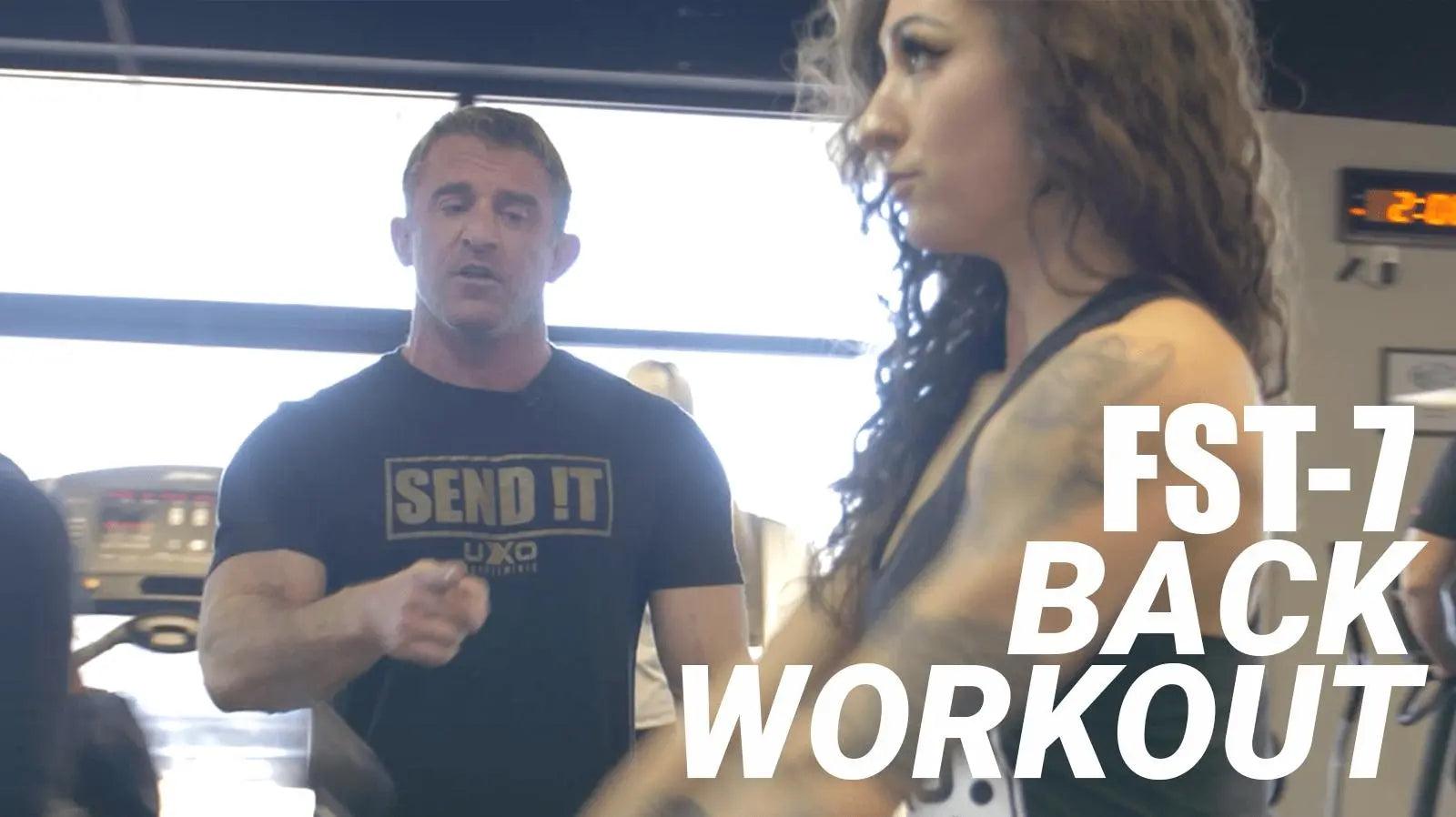
FST-7 Back Workout: 7 Sets for Bigger Lats
By Jon Klipstein, U.S. Army Combat Veteran & Founder of Die Tryin Co., and Chet Nichols, IFBB Pro & Die Tryin Co. Coach
Technique coached by Chet Nichols, IFBB Pro & Die Tryin Co. Coach.
Science reviewed by Onur Oncer, BS Physiology (Phi Beta Kappa) and peer-reviewed published researcher.
Note: this video is from our UXO Supplements era — we've since rebranded to Die Tryin Co. Same team, same standards.
SEVEN SETS TO A WIDER BACK
If you want lats that give you that wide, V-taper look, intensity techniques like FST-7 are how advanced lifters squeeze more out of a muscle. In this one, IFBB Pro Chet Nichols runs an FST-7 protocol on back — seven punishing sets of straight-arm pulldowns with stretches between — to chase a deep pump and hammer the upper lats. As he says, it works "whether you're a man or a female, to really hit that back, the upper lats, and just make it look really nice."
Here's the protocol, the straight-arm pulldown form that makes it count, the honest science behind it, and how to fit it into your training.
WHAT FST-7 ACTUALLY IS
FST-7 stands for "Fascia Stretch Training, seven sets." In Chet's words: "we do seven sets, about ten to twelve reps, and we're going to either stretch or flex the muscle for about twenty seconds, then rest for twenty seconds, and repeat." You run all seven sets on one exercise — usually as a finisher after your heavy compound work — to flood the muscle with blood and metabolic stress.
This post is the back application. For the full breakdown of where FST-7 came from and how to run it on any muscle group, see our complete FST-7 guide, and check Chet's FST-7 shoulder day for another muscle in action.
THE HONEST SCIENCE
The theory behind the name is that stretching the muscle's fascia — the connective tissue wrapping it — creates room for the muscle to grow. Here's the honest part: that specific fascia mechanism isn't well-established in the research. But everything else FST-7 does is on solid ground.
Seven sets of 10–12 reps with short, 20-second rests pile up serious training volume and metabolic stress — two well-supported drivers of muscle growth. And the straight-arm pulldown trains the lats through a deep stretch; according to a 2023 review on training technique, using a range of motion that emphasizes long muscle lengths is one of the most effective ways to maximize hypertrophy. So FST-7 works — just through established mechanisms, not fascia magic. That's also why focusing on the stretch pays off so well on back day.
THE EXERCISE: STRAIGHT-ARM PULLDOWNS
Chet's pick for back FST-7 is the straight-arm pulldown, and the cues are specific. "We want to keep the arms as straight as we can," he stresses — and that's the whole key. The setup: stand tall at the cable, lean back slightly with a small bend at the waist, and start with the bar up and the lats fully stretched.
From there, the cues stack up:
- Pull the bar down into your hip with straight arms — think of sweeping it down in an arc, not rowing it.
- Raise your chest as you pull, and "as she raises her chest, she's also going to pull her shoulders back," which is what "really engages those lats."
- Keep the arms straight. Chet's warning: "if she starts bending the arm, she's going to get the triceps involved" — bent elbows steal the work from your back. Lock the arms so the lats do everything.
- Chase the lower-lat detail. Done right, this move hits "that little Christmas tree" of lower-lat detail — Chet calls it "an excellent one for that."
Aim for 10–12 controlled reps per set, focusing every rep on the lats and nothing else.
HOW TO RUN THE 7 SETS
This is where FST-7 gets brutal. The structure for all seven sets:
- Perform a set of 10–12 straight-arm pulldowns.
- Immediately stretch or flex the lats for about 20 seconds. Chet uses a cross-body lat stretch — both hands grab one side, lean to emphasize the stretch on one lat for a few seconds, then switch and stretch the other side.
- Rest about 20 seconds.
- Repeat until you've completed all seven sets.
Keep the weight the same and the rest short. By set five or six the pump is intense — that's the entire point. As Chet says after the first round, "to complete the whole exercise, she'd have to do seven sets." Don't bail early.
COMMON MISTAKES TO AVOID
- Bending the arms. The single biggest one. The moment your elbows bend, your triceps take over and the lats get a break. Keep them straight.
- Going too heavy. Seven sets with 20 seconds of rest demands a weight you can control for clean reps deep into the protocol. Pick a load you can pump, not grind.
- Skipping the stretch. The inter-set stretch is half the method — and the straight-arm pulldown's stretched position is where the growth stimulus lives. Don't rush past it.
- Stretching the rest periods. Twenty seconds means twenty seconds. The short rest is what creates the metabolic stress that makes FST-7 work.
WHERE FST-7 FITS IN YOUR TRAINING
FST-7 is a finisher, not a whole workout. Run your heavy compound back work first — rows and weighted pulldowns where you build strength — then cap the session with one exercise taken through the 7-set FST-7 protocol to flush the lats. Because it's so demanding, once a week per muscle group is plenty.
Pair this back day with the rest of your week using our workout split guide, and for full back sessions to build the strength base first, see Jenna's back day.
FREQUENTLY ASKED QUESTIONS
What does FST-7 stand for?
Fascia Stretch Training, seven sets. You perform seven sets of one exercise with short rest and stretching between sets. The "fascia" theory behind the name is debated, but the high volume, metabolic stress, and deep stretch make it an effective growth technique.
Does FST-7 actually build more muscle?
It can, through established mechanisms — high training volume, metabolic stress, and training the muscle through a full stretch. The specific claim that stretching the fascia causes growth isn't well-supported, but the protocol itself stimulates the muscle hard.
What's the best exercise for FST-7 back?
An isolation or stretch-focused movement works best, since you're doing seven straight sets. Chet uses the straight-arm pulldown because it isolates the lats through a deep stretch. Cable rows or regular pulldowns can also work.
Why do you keep your arms straight on a straight-arm pulldown?
To keep the work on your lats. The moment you bend your elbows, your triceps and arms take over the movement. Straight arms force the lats to do the pulling, which is the entire point of the exercise.
How often should I do FST-7?
Once a week per muscle group is plenty. It's an intense finisher that creates a lot of fatigue, so it's meant to cap a workout occasionally — not replace your heavy compound training.
Is FST-7 good for beginners?
It's better suited to intermediate and advanced lifters. Beginners build the most from mastering the basic compound lifts first. Once you've got a strength base and good mind-muscle connection, FST-7 becomes a useful tool.
READY TO GEAR UP?
Chase the pump, then back it up with recovery. Prime your training with SEND IT 3.0, support output with creatine monohydrate, or take the quiz to build a stack around your goals.
ALWAYS FORWARD.
Read more
Fudgy, high-protein brownies you can feel good about — an easy recipe made with whey isolate to crush the chocolate craving and keep your gains.
IFBB Pro Chet Nichols breaks down blood flow restriction (BFR) training — how light weights and a cuff build muscle, how to use it safely, and who it's for.
The essentials
Share details of your store's product selection, or share a story that speaks to your customers.